
Dog communication is about how dogs "speak" to each other, how
that humans send to them, and how humans can translate the ideas that dogs are trying to
transmit.[1]:xii These communication behaviors include eye gaze, facial expression, vocalization,
body posture (including movements of bodies and limbs) and gustatory communication (scents,
pheromones and taste). Humans communicate with dogs by using vocalization, hand signals and
body posture.
DOG – HUMAN COMMUNICATION :
Both humans and dogs are characterized by complex social lives with rich communication
systems, but it is also possible that dogs, perhaps because of their reliance on humans for food,
have evolved specialized skills for recognizing and interpreting human social-communicative
signals. Four basic hypotheses have been put forward to account for the findings.
1. Dogs, by way of their interactions with humans, learn to be responsive to human social
cues through basic conditioning processes.[2]
2. By undergoing domestication, dogs not only reduced their fear of humans but also
applied all-purpose problem-solving skills to their interactions with people. This largely
innate gift for reading human social gestures was inadvertently selected for via
domestication.[3][4]
3. Dogs’ co-evolution with humans equipped them with the cognitive machinery to not only
respond to human social cues but to understand our mental states; a so-called theory of
mind.[5][6]
4. Dogs are adaptively predisposed to learn about human communicative gestures. In
essence they come with a built-in “head start” to learn the significance of people’s
gestures, in much the same way that white-crowned sparrows acquire their species-
typical song [7] and ducklings imprint on their own kind.[8]
The pointing gesture is a human-specific signal, is referential in its nature, and is a foundational
building block of human communication. Human infants acquire it weeks before the first spoken
word.[9] In 2009, a study compared the responses to a range of pointing gestures by dogs and
human infants. The study showed little difference in the performance of 2-year-old children and
dogs, while 3-year-old children’s performance was higher. The results also showed that all
subjects were able to generalize from their previous experience to respond to relatively novel
pointing gestures. These findings suggest that dogs demonstrate a similar level of performance
as 2-year-old children that can be explained as a joint outcome of their evolutionary history as
well as their socialization in a human environment.[10]
One study has indicated that dogs are able to tell how big another dog is just by listening to its
growl. A specific growl is used by dogs to protect their food. The research also shows that dogs
do not, or can not, misrepresent their size, and this is the first time research has shown animals
can determine another's size by the sound it makes. The test, using images of many kinds of
dogs, showed a small and big dog and played a growl. The result showed that 20 of the 24 test
dogs looked at the image of the appropriately sized dog first and looked at it longest.[11]
Depending on the context, a dog’s barks can vary in timing, pitch, and amplitude. It is possible
that these have different meanings.[12]
Additionally, most people can tell from a bark whether a dog was alone or being approached by a
stranger, playing or being aggressive,[13] and able tell from a growl how big the dog is.[14] This is
thought to be evidence of human-dog coevolution.[14]
Do you understand dog communication? Let's talk a little bit about some communication that
your dog may be having with you that you're probably not even aware of. What does it mean
when they growl or bark or howl?
What does it mean if it stares at me or rolls over on it's back when we first meet? You may know
some of what it's doing from years of experience with animals but if not, then it's really important
that you know what all those dog communication sounds and gestures with you actually
means.
So let's talk about nonverbal communication from your dog first. Now your dog will
communicate with you in many different ways but you have to remember, say for example, if it's
injured, the dog can't talk to you in a language you understand like maybe someone in your
family or a friend or coworker. But your dog does speak to you everyday - it's just in a nonverbal
form. So, what exactly is your dog trying to say to you?
Well, dogs communicate through their bodily actions and may also communicate with you by
barking or growling or other types of verbal inflections. In fact, dogs are masters of nonverbal
communication. By watching your body movements they understand much more than most
people simply by watching your movements from day to day. But do you understand what your
job is trying to say to you?
So let's talk a little bit about what some of this nonverbal dog communicationmay actually be -
and mean. First of all, let's discuss the dog's own body movements - such as its tail. Do you
understand what your dog is trying to say to you if it's tail is held between his legs? Basically
the dog is trying to tell you that it is threatened and basically this means "I'm scared". And if your
dog meets you with a really big wag of its tail then basically that means that it's meeting a
friend it hasn't seen in a while and is telling you "I'm so happy to see you."
Expressive and will often let you know right away, if you understand the language of the dog,
what the dog is thinking. They are a great means of dog communication - if you are paying
attention.
So what if the dog meets you and it's ears are relaxed. What does that mean? Basically the dog
is telling you that he's relaxed, he's comfortable and he does not feel threatened. Now if the dog
meets you and suddenly raises his ears straight up, or if you know that the dog has heard a
sound, then the dog is reacting - letting you know that the sound is interesting to them, maybe it's
something new or something that it doesn't hear very often. So basically this is just the human
equivalent of saying "what was that?"
Have you ever met a dog and you see that it's ears are laying flat against his head and they're
pulled back against it's head? This is fairly disconcerting and you should know for sure that this
means that the dog feels challenged or threatened, or that it feels that it is in a frightening
situation.
And this is often what a lot of people misunderstand and sometimes get bitten anyway because
they don't understand that the dog's ear carriage in this case is a sure sign that the dog is
upset, and the dog dog communication here is telling you that it is maybe even fearful, but ready
to bite if necessary.
And if you meet a dog and it avoids eye contact with you all together this is letting you know
that it wants to avoid any kind of confrontation with you. But, just the opposite, if you meet a dog
and it is directly staring at you on purposeand you're aware of it be aware that the dog is being
confrontational with you - even challenging you.
And this is something that you do not want to aggravate, so it's really important to understand
that you never want to meet a direct stare with a direct stare of your own as it can lead to
something very dangerous. An important form of dog communication to pay very close attention
to.
So what about body postures your dog may show you - how do you decipher this kind of dog
communication? Now we all understand that the play bow is when the dog is in a playful mood
and wants to engage you in playing with it that it will crouch down with his front legs straight out
in front of his body with it's butt still up in the air - basically this is the dog trying to encourage you
or someone/something else to play with it. But a lot of these other body postures you may not be
aware of so well.
So what happens if your dog urinates on something - what does that mean? In most cases if
a dog does this on purpose it means "this is mine" or you know that it's marking its territory so is
letting you know that it feels that this object belongs to it. Now if your dog has just gone to the
bathroom (Poopy) and he scrapes the ground with his front and back feet afterword basically this
is just letting everyone know that you should "pay attention to me" or "take note". This particular
gesture also lets other dogs know that he was here - another important form of dog
communication.
Now if your dog rolls over and exposes his belly this is a very submissive position and basically
just means that the dog is letting you be in control. But if you were to meet a dog and it was
standing with it's legs very stiff and straight this basically is a very confrontational kind of
posture and is letting you know that the dog is ready to fight basically.
So be aware if you meet a dog showing this posture - especially if the dog has his ears back or if
he is holding his tail straight out at the same time as it is standing in a stiff legged stance -
basically this is a sure sign that the dog is ready to defy whatever it is meeting up with and is
ready for confrontation.
So take the time to learn you dog communication signals. If you are not already aware of what
they mean, then good for you, but if not, do yourself a favor and begin learning them now. It
could be one of the best things that you ever learned.
Learn body language of germany sherperd :
Good Signs:
Tail wagging fast & wide -
"It's SO good to see you!"
This is an excited and happy dog.
Holding tail erect -
"Yeah, I'm all that."
Exudes confidence and control.
Tail lowered -
"Just chillin'"
A relaxed dog will keep her tail down. But, it will not be between her legs.
Corners of the mouth pulled back to show teeth (not as in a snarl)
"I'm no threat to you."
This is considered a smile.
Lying with one paw tucked under -
"Feel free to pet me."
A happy and relaxed dog.
Cock of the head or ear twitch -
"What's going on?"
Usually shows interest, but may sometimes mean fear.
Ears forward -
"Something new or exciting is approaching."
Tying to figure out where a sound is coming from.
Rolling belly-up while exposing her neck
and/or genitals -
"You're the boss!"
This is a sign of submissiveness.
Bowing down on front paws with rear end in the air and tail wagging -"C'mon,
let's play!"
Trying to entice you (or another dog) to play. She may also paw the air or
ground and bark.
Unsure Signs:
Tail wagging slowly -
"Are you a friend or foe?"
Don't expect a big kiss until she feels comfortable with you.
Holding tail horizontally, but loosely -
"I need to find out more about you."
Not yet ready to welcome you, but will not challenge you.
Tail tucked between the legs -
"I give up."
Most likely afraid.
Head is down and ears are back -
"I am scared" or "I'm not looking for any trouble."
Frightened or submissive.
Red Flags:
One paw raised -
"Don't bother me."
Not happy and not in a mood to be petted.
Holding tail horizontally, but stiffly and wagging fast -
"I mean business!"
Agitated and most likely aggressive.
Raised upper lip and teeth bared -
"I'm warning you."
A snarl is an unmistakable threat.
Whites of eyes showing in a "half moon" -
"Leave me alone!"
Does not want to be bothered.
Freezes or suddenly becomes stiff -
"I may bite you."
Do not touch this dog.
Fur along the back and neck bristle -
"I may need to attack in self-defense."
Frightened or submissive. May be shy or timid, but will attack if cornered.
Tails Tell a Tale
A recent study confirms signs of dog body language. A dog will wag her tail
predominantly to the right when she is feeling positive or happy thoughts about
something or someone. And the reverse is also true. When a dog perceives
something potentially negative, her tail will wag more towards the left.

This fascinating study, "Asymmetric tail-wagging responses by dogs to different
emotive stimuli," appeared in the March 20, 2007 issue of Current Biology.
Apparently the muscles on the right side of the tail are much more apt to reflect good
emotions, while the left side is more prone to showing bad ones.
As the Dog Whisperer says...
"Be The Pack Leader"
The pack instinct will make you a great observer. You will pay closer attention to
everybody and everything around you.
Though you may not realize it, your dog watches and listens to you... All the time.
She learns your patterns of behavior.
Sometimes, you may think that she can read your mind. But, her ability to predict
your next move is a result of very good observation skills.
that humans send to them, and how humans can translate the ideas that dogs are trying to
transmit.[1]:xii These communication behaviors include eye gaze, facial expression, vocalization,
body posture (including movements of bodies and limbs) and gustatory communication (scents,
pheromones and taste). Humans communicate with dogs by using vocalization, hand signals and
body posture.
DOG – HUMAN COMMUNICATION :
Both humans and dogs are characterized by complex social lives with rich communication
systems, but it is also possible that dogs, perhaps because of their reliance on humans for food,
have evolved specialized skills for recognizing and interpreting human social-communicative
signals. Four basic hypotheses have been put forward to account for the findings.
1. Dogs, by way of their interactions with humans, learn to be responsive to human social
cues through basic conditioning processes.[2]
2. By undergoing domestication, dogs not only reduced their fear of humans but also
applied all-purpose problem-solving skills to their interactions with people. This largely
innate gift for reading human social gestures was inadvertently selected for via
domestication.[3][4]
3. Dogs’ co-evolution with humans equipped them with the cognitive machinery to not only
respond to human social cues but to understand our mental states; a so-called theory of
mind.[5][6]
4. Dogs are adaptively predisposed to learn about human communicative gestures. In
essence they come with a built-in “head start” to learn the significance of people’s
gestures, in much the same way that white-crowned sparrows acquire their species-
typical song [7] and ducklings imprint on their own kind.[8]
The pointing gesture is a human-specific signal, is referential in its nature, and is a foundational
building block of human communication. Human infants acquire it weeks before the first spoken
word.[9] In 2009, a study compared the responses to a range of pointing gestures by dogs and
human infants. The study showed little difference in the performance of 2-year-old children and
dogs, while 3-year-old children’s performance was higher. The results also showed that all
subjects were able to generalize from their previous experience to respond to relatively novel
pointing gestures. These findings suggest that dogs demonstrate a similar level of performance
as 2-year-old children that can be explained as a joint outcome of their evolutionary history as
well as their socialization in a human environment.[10]
One study has indicated that dogs are able to tell how big another dog is just by listening to its
growl. A specific growl is used by dogs to protect their food. The research also shows that dogs
do not, or can not, misrepresent their size, and this is the first time research has shown animals
can determine another's size by the sound it makes. The test, using images of many kinds of
dogs, showed a small and big dog and played a growl. The result showed that 20 of the 24 test
dogs looked at the image of the appropriately sized dog first and looked at it longest.[11]
Depending on the context, a dog’s barks can vary in timing, pitch, and amplitude. It is possible
that these have different meanings.[12]
Additionally, most people can tell from a bark whether a dog was alone or being approached by a
stranger, playing or being aggressive,[13] and able tell from a growl how big the dog is.[14] This is
thought to be evidence of human-dog coevolution.[14]
Do you understand dog communication? Let's talk a little bit about some communication that
your dog may be having with you that you're probably not even aware of. What does it mean
when they growl or bark or howl?
What does it mean if it stares at me or rolls over on it's back when we first meet? You may know
some of what it's doing from years of experience with animals but if not, then it's really important
that you know what all those dog communication sounds and gestures with you actually
means.
So let's talk about nonverbal communication from your dog first. Now your dog will
communicate with you in many different ways but you have to remember, say for example, if it's
injured, the dog can't talk to you in a language you understand like maybe someone in your
family or a friend or coworker. But your dog does speak to you everyday - it's just in a nonverbal
form. So, what exactly is your dog trying to say to you?
Well, dogs communicate through their bodily actions and may also communicate with you by
barking or growling or other types of verbal inflections. In fact, dogs are masters of nonverbal
communication. By watching your body movements they understand much more than most
people simply by watching your movements from day to day. But do you understand what your
job is trying to say to you?
So let's talk a little bit about what some of this nonverbal dog communicationmay actually be -
and mean. First of all, let's discuss the dog's own body movements - such as its tail. Do you
understand what your dog is trying to say to you if it's tail is held between his legs? Basically
the dog is trying to tell you that it is threatened and basically this means "I'm scared". And if your
dog meets you with a really big wag of its tail then basically that means that it's meeting a
friend it hasn't seen in a while and is telling you "I'm so happy to see you."
Expressive and will often let you know right away, if you understand the language of the dog,
what the dog is thinking. They are a great means of dog communication - if you are paying
attention.
So what if the dog meets you and it's ears are relaxed. What does that mean? Basically the dog
is telling you that he's relaxed, he's comfortable and he does not feel threatened. Now if the dog
meets you and suddenly raises his ears straight up, or if you know that the dog has heard a
sound, then the dog is reacting - letting you know that the sound is interesting to them, maybe it's
something new or something that it doesn't hear very often. So basically this is just the human
equivalent of saying "what was that?"
Have you ever met a dog and you see that it's ears are laying flat against his head and they're
pulled back against it's head? This is fairly disconcerting and you should know for sure that this
means that the dog feels challenged or threatened, or that it feels that it is in a frightening
situation.
And this is often what a lot of people misunderstand and sometimes get bitten anyway because
they don't understand that the dog's ear carriage in this case is a sure sign that the dog is
upset, and the dog dog communication here is telling you that it is maybe even fearful, but ready
to bite if necessary.
And if you meet a dog and it avoids eye contact with you all together this is letting you know
that it wants to avoid any kind of confrontation with you. But, just the opposite, if you meet a dog
and it is directly staring at you on purposeand you're aware of it be aware that the dog is being
confrontational with you - even challenging you.
And this is something that you do not want to aggravate, so it's really important to understand
that you never want to meet a direct stare with a direct stare of your own as it can lead to
something very dangerous. An important form of dog communication to pay very close attention
to.
So what about body postures your dog may show you - how do you decipher this kind of dog
communication? Now we all understand that the play bow is when the dog is in a playful mood
and wants to engage you in playing with it that it will crouch down with his front legs straight out
in front of his body with it's butt still up in the air - basically this is the dog trying to encourage you
or someone/something else to play with it. But a lot of these other body postures you may not be
aware of so well.
So what happens if your dog urinates on something - what does that mean? In most cases if
a dog does this on purpose it means "this is mine" or you know that it's marking its territory so is
letting you know that it feels that this object belongs to it. Now if your dog has just gone to the
bathroom (Poopy) and he scrapes the ground with his front and back feet afterword basically this
is just letting everyone know that you should "pay attention to me" or "take note". This particular
gesture also lets other dogs know that he was here - another important form of dog
communication.
Now if your dog rolls over and exposes his belly this is a very submissive position and basically
just means that the dog is letting you be in control. But if you were to meet a dog and it was
standing with it's legs very stiff and straight this basically is a very confrontational kind of
posture and is letting you know that the dog is ready to fight basically.
So be aware if you meet a dog showing this posture - especially if the dog has his ears back or if
he is holding his tail straight out at the same time as it is standing in a stiff legged stance -
basically this is a sure sign that the dog is ready to defy whatever it is meeting up with and is
ready for confrontation.
So take the time to learn you dog communication signals. If you are not already aware of what
they mean, then good for you, but if not, do yourself a favor and begin learning them now. It
could be one of the best things that you ever learned.
Learn body language of germany sherperd :
Good Signs:
Tail wagging fast & wide -
"It's SO good to see you!"
This is an excited and happy dog.
Holding tail erect -
"Yeah, I'm all that."
Exudes confidence and control.
Tail lowered -
"Just chillin'"
A relaxed dog will keep her tail down. But, it will not be between her legs.
Corners of the mouth pulled back to show teeth (not as in a snarl)
"I'm no threat to you."
This is considered a smile.
Lying with one paw tucked under -
"Feel free to pet me."
A happy and relaxed dog.
Cock of the head or ear twitch -
"What's going on?"
Usually shows interest, but may sometimes mean fear.
Ears forward -
"Something new or exciting is approaching."
Tying to figure out where a sound is coming from.
Rolling belly-up while exposing her neck
and/or genitals -
"You're the boss!"
This is a sign of submissiveness.
Bowing down on front paws with rear end in the air and tail wagging -"C'mon,
let's play!"
Trying to entice you (or another dog) to play. She may also paw the air or
ground and bark.
Unsure Signs:
Tail wagging slowly -
"Are you a friend or foe?"
Don't expect a big kiss until she feels comfortable with you.
Holding tail horizontally, but loosely -
"I need to find out more about you."
Not yet ready to welcome you, but will not challenge you.
Tail tucked between the legs -
"I give up."
Most likely afraid.
Head is down and ears are back -
"I am scared" or "I'm not looking for any trouble."
Frightened or submissive.
Red Flags:
One paw raised -
"Don't bother me."
Not happy and not in a mood to be petted.
Holding tail horizontally, but stiffly and wagging fast -
"I mean business!"
Agitated and most likely aggressive.
Raised upper lip and teeth bared -
"I'm warning you."
A snarl is an unmistakable threat.
Whites of eyes showing in a "half moon" -
"Leave me alone!"
Does not want to be bothered.
Freezes or suddenly becomes stiff -
"I may bite you."
Do not touch this dog.
Fur along the back and neck bristle -
"I may need to attack in self-defense."
Frightened or submissive. May be shy or timid, but will attack if cornered.
Tails Tell a Tale
A recent study confirms signs of dog body language. A dog will wag her tail
predominantly to the right when she is feeling positive or happy thoughts about
something or someone. And the reverse is also true. When a dog perceives
something potentially negative, her tail will wag more towards the left.
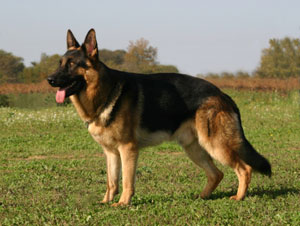
This fascinating study, "Asymmetric tail-wagging responses by dogs to different
emotive stimuli," appeared in the March 20, 2007 issue of Current Biology.
Apparently the muscles on the right side of the tail are much more apt to reflect good
emotions, while the left side is more prone to showing bad ones.
As the Dog Whisperer says...
"Be The Pack Leader"
The pack instinct will make you a great observer. You will pay closer attention to
everybody and everything around you.
Though you may not realize it, your dog watches and listens to you... All the time.
She learns your patterns of behavior.
Sometimes, you may think that she can read your mind. But, her ability to predict
your next move is a result of very good observation skills.

0 komentar :
Post a Comment